

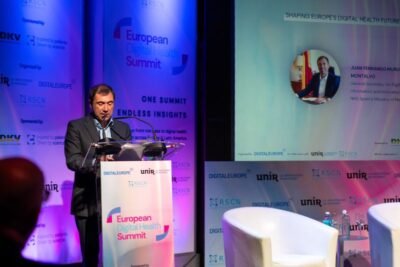





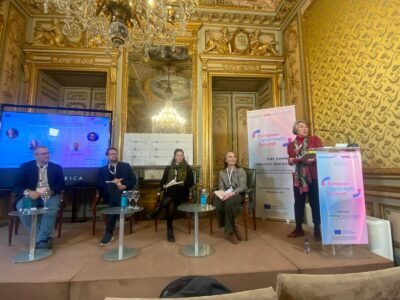



Europe’s digital health must be a source of trust, innovation and global leadership, experts agree at the ‘European Digital Health Summit’
Madrid/Logroño, 1 December 2025
Europe must move towards a joint, intelligent and coordinated digital health system to generate trust, innovation and global leadership, according to experts gathered at the European Digital Health Summit.
This meeting, organised by the International University of La Rioja (UNIR), DIGITALEUROPE the leading European association of industries undergoing digital transformation and the Reference Site Collaborative Network (RSCN), is the largest digital health event in Europe, and it is the first time it is being held in Spain. It will continue tomorrow, Tuesday.
This European Digital Health Summit is part of the NET4DHE (“Network for Digital Health Excellence”) project, funded by the EU4Health programme of the European Commission, aimed at strengthening the European ecosystem for digital transformation in health.
Over two days, experts address the most urgent health challenges facing Europe, promoting collaboration and coordination among Member States, public and private sectors, civil society, researchers and academics.
This important congress on digital health demonstrates that Artificial Intelligence, access to health data and training are key elements for the digitalisation of health in Europe.
A key moment
Spain hosts this event at a critical time, when the European digital health market reached €109.6 billion in 2024 and is expected to reach €272.5 billion by 2033.
In our country in particular, more than 2,100 digital health startups attracted €114 million in 2024, and the national strategy foresees more than €700 million in investment for healthcare digitalisation.
Furthermore, this meeting drives digital transformation in health to strengthen health systems, advance the “One Health” approach, improve access to medicines and promote the adoption of digital technologies, aligning national strategies with the EU’s common health objectives.
According to José Martínez-Usero, Director of Projects at DIGITALEUROPE, “in Europe’s health systems, digital is no longer an accessory but the backbone for creating more resilient, personalised and sustainable systems.”
He adds that “the European Congress on Digital Health is in fact a platform where we bring together public authorities, industry, researchers, healthcare professionals and patients at the same table to turn health data and innovation into real results and new business opportunities in the European single market.”
European Health Data Space
One of the main challenges for digital health focuses on the “European Health Data Space”, a European initiative that will provide health systems and innovators with the information needed to develop and implement safe and effective AI solutions in real clinical settings.
This initiative requires coordinated collaboration among Member States, but it also raises challenges for ethical use and personal data protection.
According to Marco Marsella, Director of the programme ‘Digital, EU4Health and Health Systems Modernisation’ at the European Commission, “the European healthcare sector can greatly benefit from artificial intelligence, which can already support diagnostic and treatment decisions while reducing administrative and financial pressure on health systems.”
In this regard, Marsella highlights that “to fully leverage this potential, we need trust, high-quality health data and scale.”
In recent years, the Commission has established the legal foundations for trustworthy artificial intelligence in healthcare through legislation such as the AI Act, the Medical Devices Regulation and the Regulation on the European Health Data Space (EHDS), while actively promoting innovation and adoption of AI.
Research, training and knowledge transfer to meet market demands
The academic sector also plays a key role in building an innovative and competitive healthcare ecosystem.
Rafael Puyol, President of the International University of La Rioja (UNIR), notes that “digital environments must serve healthcare professionals so they can combine the accessibility and availability of resources with the precision and efficiency of videoconference-based training.”
In the same line, Daniel Burgos, Vice-Rector for International Research Projects at UNIR, emphasises that “academic and technological innovation must be among the main mechanisms for offering education aligned with the real demands of students and society,” especially in a context where technologies applied to health evolve rapidly.
University-based research and knowledge transfer, as well as the networks and projects emerging from these collaborations, can generate high-impact initiatives—from spin-offs and technological developments to international agreements for large-scale scientific projects.
Evidence of this dynamism is that more than 2,100 digital health startups/scale-ups in Spain raised nearly €114 million in 61 operations during 2024, demonstrating strong entrepreneurial activity.
According to experts, the connection between universities and the business ecosystem allows anticipation of market needs and adjustment of training to emerging professional profiles, preparing students to become the future specialists demanded by the healthcare sector in the coming years.
Presence of public and private institutions
The summit included the participation of public institutions, which will outline a joint proposal for European digital health.
Among the participants were Miguel López Valverde, Regional Minister for Digitalisation of the Community of Madrid; Juan Fernando Muñoz Montalvo, Secretary-General for Digital Health, Information and Innovation of the Spanish National Health System; and Ruth del Campo, Director-General for Data at the Ministry for Digital Transformation and Public Service (Government of Spain).
Private institutions such as DKV and the pharmaceutical company UCB also took part in the summit as part of the healthcare ecosystem preparing for digital transformation in the health sector.